

ZARM Talk: Bubble breakup in turbulence
What makes bubbles suddenly break in turbulence? On Sep 16th, Aliénor Riviere explains how random flow fluctuations trigger breakup, using stochastic models and stability analysis to reveal surprising bubble motions and a new deformation mode.
ZARM Talk by Aliénor Riviere
École Polytechnique Fédérale de Lausanne (EPFL)
• Date: 16 September 2026
• Time: 13:15 hrs.
• Location: ZARM, room 1280
Bubble breakup in turbulence: From stochastic modeling to linear stability analysis
In turbulent flows, bubble fate is controlled by the ratio between inertia and capillarity, namely the Weber number. There exists a critical Weber number which separates, in average, breaking from non-breaking bubbles. However, this limit is only defined in a statistical sense as an a priori stable bubble can encounter a large velocity or pressure fluctuation and break. In addition, real flows are rarely homogeneous and stationary. In this work, we aim at quantifying the probability for a bubble to break as a function of the time spent within the turbulence region and to rationalize the bubble breakup time.
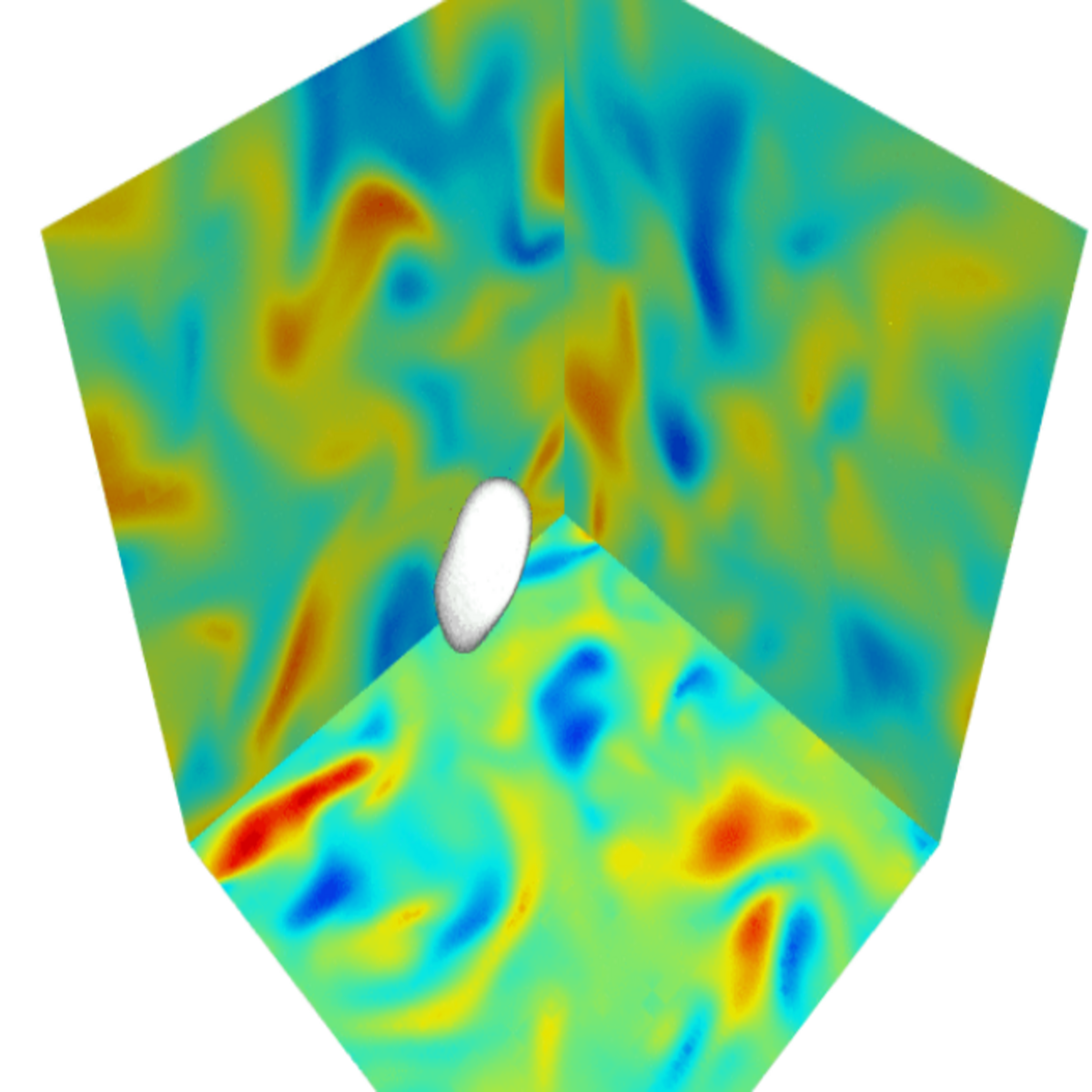
To do so, running direct numerical simulations, we first characterize the linear stochastic deformations of bubbles in homogeneous isotropic turbulence. We show that a 1D model describing oblate/prolate deformations is sufficient to capture most of bubble deformations, as well as predicting bubble lifetime provided the forcing statistics and the bubble response are correctly parametrized. To further rationalize the forcing statistics measured in the DNS, we propose to decompose the turbulent flow field into a sequence of elementary flows and to characterize bubble dynamics in each of them. We identify two main effective flow candidates, namely the uniaxial straining flow (USF) and the biaxial straining flow (BSF). While the first one has received considerable attention, little is known on the dynamics of bubble in BSF. In this talk, we present the linear stability analysis of bubble deformations in this flow. We enlighten surprising drift modes moving upstream as well as a new deformation mode with azimuthal wave number m=2, which might explain some of the breakage observed experimentally in turbulence.